What to Expect During Your First Pest Control Service in Visakhapatnam
Calling a pest control professional for the first time can feel a little uncertain. You may wonder what the technician will do, whether you need to prepare your home, how long the treatment will take, and what you should expect afterward.
The good news is that a professional pest control service is usually a straightforward process. A trained technician first understands the pest problem, inspects the property, recommends the appropriate treatment, and then takes steps to control the infestation and reduce the chances of it returning.
For homeowners in Visakhapatnam, where warm temperatures, humidity, and seasonal rainfall can encourage pest activity, professional pest management can be an important part of keeping a home clean and comfortable.
Why Your First Pest Control Visit Matters
Your first service is more than simply spraying for insects. It gives the pest control professional an opportunity to understand what is happening inside and around your property.
During the visit, the technician may look for:
- Visible pest activity
- Pest hiding places
- Entry points around doors and windows
- Cracks and gaps
- Moisture-prone areas
- Food or waste sources
- Signs of nests or breeding areas
- Damage caused by pests
This inspection helps determine the most suitable approach for your property.
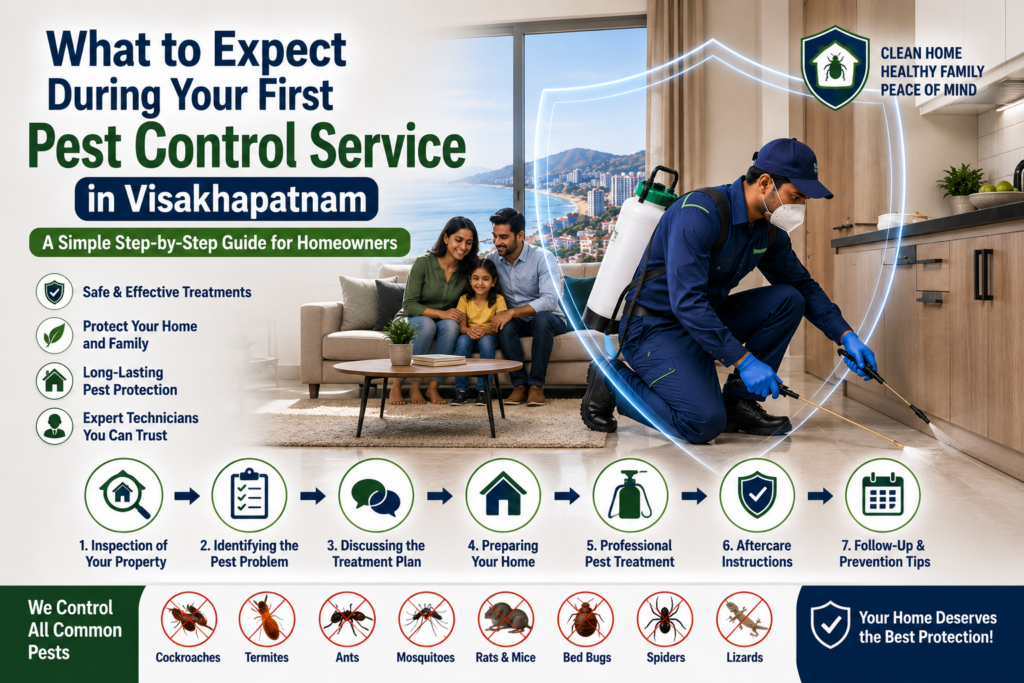
Step 1: Property Inspection
The first step is usually a detailed inspection.
The technician may check areas such as the kitchen, bathrooms, bedrooms, balconies, storage spaces, gardens, and other areas where pest activity has been noticed.
For certain pests, additional attention may be given to furniture, drains, wooden structures, walls, or outdoor areas.
The purpose is to understand the type and extent of the infestation instead of treating only the pests that are immediately visible.
Step 2: Identifying the Pest Problem
Different pests require different treatment methods.
For example, cockroach control may involve treatment around kitchens, cabinets, and other hiding areas, while termite control requires a completely different approach.
Common household pest problems include:
- Cockroaches
- Termites
- Mosquitoes
- Rodents
- Bed bugs
- Ants
- Spiders
- Lizards
Identifying the pest correctly allows the technician to choose an appropriate treatment strategy.
Step 3: Discussing the Treatment Plan
After the inspection, the technician should explain the recommended treatment.
You can expect to discuss:
- What pest has been identified
- Where the infestation appears to be concentrated
- Which areas need treatment
- What preparation may be required
- How the treatment will be carried out
- Any precautions you should follow afterward
A clear explanation helps you understand what is happening rather than leaving you guessing.
Step 4: Preparing Your Home
Depending on the type of pest and treatment, you may need to prepare certain areas before the service.
Simple preparation may include:
- Cleaning food preparation areas
- Storing food properly
- Clearing clutter from treatment areas
- Moving easily accessible items away from walls
- Keeping children and pets away from treatment areas when advised
- Providing access to areas where pest activity has been noticed
The exact preparation requirements can vary depending on the treatment.
Step 5: Professional Pest Treatment
Once the property is ready, the technician carries out the treatment using suitable equipment and treatment methods.
The areas treated depend on the pest problem. For example, cockroach treatment may focus on kitchens and hiding areas, while mosquito control may involve outdoor areas and potential breeding locations.
For termite problems, treatment may focus on affected wooden structures or other areas identified during inspection.
Professional treatment is designed to address the infestation more systematically than simply spraying visible pests.
Step 6: Understanding the Aftercare Instructions
After the treatment, the technician may provide instructions about what you should and shouldn’t do.
These instructions can depend on the type of treatment used.
You may be advised to:
- Keep treated areas undisturbed for a specified period
- Follow any recommended ventilation instructions
- Keep children and pets away from treated areas until it is considered safe
- Avoid immediately cleaning certain treated surfaces when instructed
- Maintain good hygiene and housekeeping practices
Always follow the specific instructions provided by the pest control professional.
Don’t Be Alarmed If You Still See Some Pests
One common misconception is that every pest should disappear immediately after the first treatment.
Depending on the type and severity of the infestation, you may still notice some pest activity for a period after treatment. Hidden pests may emerge from their hiding places, and some infestations require follow-up treatment.
If pest activity continues, communicate with your pest control provider rather than assuming the treatment has failed.
How Long Does a Pest Control Service Take?
The duration depends on several factors, including:
- Size of the property
- Type of pest
- Level of infestation
- Number of areas requiring treatment
- Treatment method being used
A small residential treatment may take less time than treating a larger house or commercial property.
Your technician can provide a more accurate estimate after inspecting the property.
What Happens After the Treatment?
The goal of professional pest control is not only to deal with the current infestation but also to reduce the possibility of future pest activity.
You can help maintain the results by:
- Keeping your home clean
- Storing food properly
- Removing stagnant water
- Fixing leaking pipes
- Keeping garbage covered
- Sealing cracks and gaps
- Maintaining gardens and outdoor areas
- Following recommended pest control schedules
Good household maintenance can make professional pest control more effective.
When Should You Consider Follow-Up Treatment?
Some pest problems may require more than one visit.
Follow-up treatment may be recommended when:
- The infestation is severe
- Pest eggs remain after the initial service
- The pest has a long life cycle
- The treatment requires multiple stages
- Pest activity continues after the first visit
Bed bugs and termites, for example, can sometimes require more extensive treatment than a minor ant or cockroach problem.
Why Choose SR Pest Control in Visakhapatnam?
At SR Pest Control, we provide professional pest management solutions for homes, offices, commercial properties, gardens, and industrial spaces across Visakhapatnam.
Our services include:
- Cockroach Control
- Termite Control
- Mosquito Control
- Rodent Control
- Bed Bug Control
- Ant Control
- Spider Control
- Lizard Control
Our approach focuses on proper inspection, suitable treatment methods, safety, and long-term pest prevention.
We aim to make the pest control process simple and convenient for homeowners while providing effective solutions for common pest problems.
Tips for a Smooth First Pest Control Service
If this is your first professional pest control appointment, a little preparation can make the experience easier.
Make sure you:
- Tell the technician where you have noticed pests.
- Mention how long you’ve been experiencing the problem.
- Point out any visible nests, droppings, damage, or pest trails.
- Ask what preparation is required.
- Follow all safety and aftercare instructions.
- Ask whether follow-up treatment is recommended.
- Keep the contact details of your pest control provider for future assistance.
Being open about the problem helps the technician understand your situation more accurately.
Conclusion
Your first pest control service doesn’t need to be complicated. The process generally begins with an inspection, followed by pest identification, treatment planning, professional treatment, and aftercare guidance.
For homeowners searching for Pest Control Services in Visakhapatnam, choosing an experienced professional can make it easier to handle cockroaches, termites, mosquitoes, rodents, bed bugs, ants, spiders, and other common household pests.
With the right treatment and regular preventive care, you can protect your home, maintain better hygiene, and enjoy a more comfortable pest-free environment.